Hey Reader,
THIS WEEK
Every market has a shared definition of what the game is. Not agreed upon in any meeting. It simply emerges from the collective behavior of every serious player competing on the same terms, measuring the same things, chasing the same customers. And because every serious player is doing it, the definition feels correct.
What that definition conceals is the most important competitive question in your market. Almost nobody is asking it. The ones who never do are building on ground they do not own.
FEATURE
In 1870, every serious player in the American oil industry was competing for the same thing.
The Pennsylvania oil fields had been producing for over a decade and the market logic was clear to everyone who had studied it: drill more, refine faster, price cheaper. The producers who pulled the most oil from the ground, processed it fastest, and delivered it cheapest would win. The evidence supported it. The biggest players were doing it. Everything pointed in the same direction
But, John D. Rockefeller reached a different conclusion entirely.
He was not interested in drilling more oil. He was not trying to build a faster refinery or develop a superior extraction technology. He was interested in something every oil producer in the Pennsylvania fields needed but no one had decided was worth competing for: the systems that moved oil from the ground to the customer. The railroads that carried it. The refineries that processed it. The pipelines that transported it. Every driller, regardless of how much oil they pulled from the ground, was completely dependent on this layer to reach their customer.
Rockefeller did not compete for oil. He competed for everything oil depended on.
Between 1870 and 1882, Rockefeller moved quietly and deliberately across every part of the oil business that nobody else thought was worth owning.
He started with the railroads. He negotiated private deals with the major rail companies, deals that gave Standard Oil cheaper shipping rates than any competitor could access. But the arrangement went further than that. Every time an independent oil producer used the same railroad, a portion of what they paid in shipping costs came back to Rockefeller. His competitors were using their own money to fund the man they were trying to beat. They just did not know it.
Then he moved to the refineries. He began acquiring processing facilities across Cleveland, Pittsburgh, and New York. Not to produce more oil himself, but to take control of the facilities his competitors needed to turn their oil into a product they could actually sell. By 1879, Standard Oil controlled roughly 90 percent of all oil refining in America.
The independent producers had been drilling harder, moving faster, working to pull more oil from the ground than anyone else. They believed that was the game. They were right about the game. They were wrong about who controlled it. The man they thought they were competing against now owned the only system that could convert their oil into money.
The move that kills a business is rarely the one you see coming. It is the one happening under you.
But Rockefeller was not finished. The railroad deals were profitable, but he recognized a problem with them. He did not own the railroads. If the rail companies changed their terms, or if a competitor grew large enough to negotiate similar rates, the advantage would disappear overnight. So he built pipelines. By the early 1880s, Standard Oil's pipeline network ran directly through the major oil producing regions, moving oil straight from the ground to the refinery to the customer. He no longer needed the railroads. He had replaced a relationship he depended on with an asset he owned outright.
By the time everyone else understood what had happened, there was nothing left to do about it. The independent producers had worked hard, competed seriously, and played the game exactly as the market had defined it. The problem was never their effort. It was their focus. They had spent everything competing for oil while Rockefeller spent everything building the system oil moved on. He did not beat them at the visible game. He built the ground the visible game was being played on and quietly collected from every single player on it.
Every market today has its own version of what Rockefeller built. It is not always pipelines or railroads. Sometimes it is a distribution channel that every business in the industry depends on to reach their customers. Sometimes it is a data asset, information that grows more valuable the longer you hold it, giving whoever owns it a clearer picture of the market than anyone else can access. Sometimes it is a platform relationship that controls who gets visibility and who does not. Sometimes it is a regulatory approval, an industry certification, or the single training program every competitor pulls their best talent from.
The form changes. The function is always the same.
The question worth sitting with is not who is currently winning your market. It is whether anyone has already started building the layer your market's current competition depends on, and whether that person is you.
BELOW THE SURFACE
The railroad deals did something beyond giving Rockefeller cheaper shipping rates.
As part of the arrangement, the railroads were required to share data on every shipment that passed through their network. Volume, destinations, customers, timing. Every independent producer who loaded oil onto a railroad car was, without knowing it, handing Rockefeller a detailed picture of their own business. He knew their customers before he approached them. He knew their volumes before he bought their refineries. He knew their routes before his pipelines made those routes irrelevant.
The system Rockefeller built was not just a way to move oil. It was a way to see everything.
Owning the chokepoint that every competitor passed through meant he could see the entire market clearly. That advantage came automatically as a direct consequence of owning the layer every competitor depended on.
The business that owns the distribution channel sees which customers are being underserved before anyone else thinks to look. The business that owns the data asset spots the pattern before it becomes visible to the market. Nobody is feeding them this intelligence deliberately. It arrives as a natural consequence of owning the layer everyone else passes through.
THE DEEPER CUT
|
|
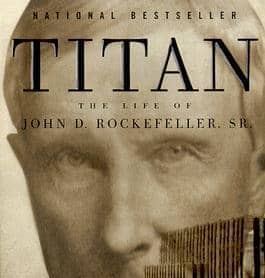
Titan: The Life of John D. Rockefeller Sr. by Ron Chernow earns its place here because it is the only book that treats what Rockefeller did as a deliberate strategic system rather than a simple story of greed and power. |

