Hey Reader,
THIS WEEK
The founders I speak with almost always measure competitive advantage in the present tense. "What do we have now that they don't?" The question itself is the problem. By the time an advantage is visible, it has already lost its edge. Your competitor has started responding. What are you building that no one has begun to respond to yet? Because that is the only advantage that still carries its full weight.
FEATURE
One morning, on October 20th, 1805, an Austrian general named Karl Mack surrendered his 72,000 men without fighting a single major battle.
This is how the most consequential losses actually happen.
Mack had every reason to feel secure in the weeks leading up to that morning. His army was positioned near the Bavarian town of Ulm, well-supplied, and waiting. Austrian intelligence had been tracking Napoleon's preparations along the English Channel coast, five hundred miles to the northwest where the Grande Armée had been assembled in what appeared to be the staging of an invasion of England. The threat was in the northwest. The Danube corridor was safe. When the campaign came, Mack expected it to develop on terms he understood and had prepared for. What he did not know was that Napoleon had already moved.
Three weeks before Mack suspected anything, the Grande Armée broke camp from the Channel coast and began marching 210,000 men across seven parallel roads at the same time. The operation was too large to hide, so Napoleon did not try to hide it. He hid the direction instead. By the time Austrian intelligence pieced together any clear picture of what was happening, French forces had already crossed into Bavaria. They were not heading toward Ulm. They were swinging wide to the north, crossing the Danube behind Mack's position, cutting him off from Vienna, from his supplies, from any chance of reinforcement.
When Mack finally understood the full picture, the encirclement was already complete. Napoleon did not defeat Mack in battle. He made Mack's position impossible to hold before Mack had any framework for understanding that the campaign had already started.
Carl von Clausewitz, the Prussian general who wrote the text on military strategy, spent his career studying exactly this kind of operation, and he put the distinction in the simplest terms possible: tactics is about winning the fight in front of you. Strategy is about making sure the fight you enter is already won before it begins. The battle, the visible clash that everyone watches, is where tactics plays out. But the outcome was settled somewhere else entirely. In the preparation happening while the enemy is still working from the wrong picture.
By the time two sides are fighting, the strategist has already finished his real work.
The battle at Ulm was almost a formality. Mack did not lose on October 20th. He lost in the three weeks before it, in the places he was not watching, to a campaign he did not know had already started. The surrender was simply the moment that reality became impossible to ignore.
The structural mechanism at Ulm operates identically inside competitive business, and it is almost never recognized until it is too late to respond.
Translate the campaign into business terms and the structure holds exactly: Napoleon identified the decisive terrain before his opponent did, built his capability to occupy it in advance, and executed from a position of structural dominance that his competitor had no framework to anticipate. The fighting, what most observers would call "the competition", was nearly irrelevant. The outcome was locked in the preparation.
Most business operators are trained to compete in the present. To respond to visible moves. To match capabilities. To fight the battle in front of them. The entire language of competitive intelligence is built around this, tracking what competitors are releasing, reacting to market signals, responding to customer demands that have already surfaced. It is tactics fully developed.
The competition you can see is not the competition that will actually threaten you. The companies building quietly: repositioning, accumulating, encircling, are the ones you have no map for yet.
This is the mechanism that requires a mode of thinking that the daily demands of execution systematically suppress. The founder fighting the battle directly in front of them is not wrong to fight it. That fight is real and it cannot be ignored. But somewhere, a competitor is doing something more dangerous than winning the current battle. They are building the position that makes every future battle unwinnable. That is the business operating at a completely different level.
The companies that will hold meaningful ground in the next decade are not going to win by being better at the competition everyone can see. They are going to win because they built capability in territory their competitors had not yet decided to contest. They are going to win because they are already crossing the Danube while the market is still watching the English Channel.
The strategic question is no longer: what are our competitors doing? It becomes: what terrain, if we occupy it quietly, makes our competitors' current positions increasingly untenable? What capability, built without announcement, without press release, creates a structural problem for every player in the industry the moment it becomes visible?
Mack was not unintelligent. He was not outfought. He was outthought before the fighting started. His intelligence picture was accurate as far as it went. He simply had no framework for the possibility that the campaign had already begun somewhere he was not looking.
BELOW THE SURFACE
Napoleon's victory at Ulm was not just about how fast the French army moved. It was about what Napoleon allowed the Austrians to see while it was moving. French cavalry rode ahead of the main army specifically to intercept Austrian scouts before they could observe anything and report back. So the intelligence Mack received was fragmented, delayed, and systematically incomplete. He was not an uninformed general making bad decisions. He was a well-informed general making reasonable decisions from a picture of reality that had been quietly curated by his opponent.
What you choose to make visible during a period of strategic repositioning is itself a competitive decision. The company that announces its pivot loudly gifts competitors the one thing they needed most: time. Time to respond, to replicate, to block the crossing. The company that builds quietly, behind the ordinary activity of running the business, arrives at the decisive position before the landscape has shifted to account for it.
This is not secrecy as a virtue. It is recognition that structural advantage compounds fastest when it develops uncontested. The window between when you begin building and when competitors recognize what you are building is your most valuable period. You will never have more freedom of action than you have inside that window.
The question is not whether to compete. The question is whether to telegraph the terms of the competition before you are ready to execute.
Napoleon called it the fog of war. He manufactured as much of it as possible.
THE DEEPER CUT
|
|
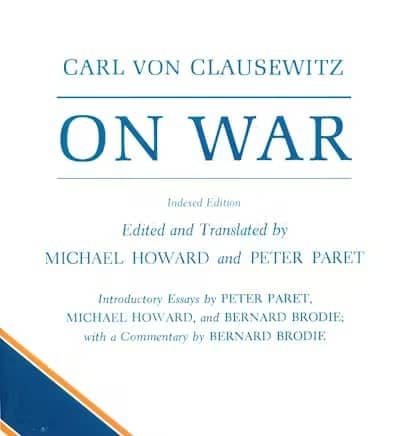
On War by Carl von Clausewitz, the Prussian general whose work became the foundation of modern strategic thinking, earns its place here because it is the only strategic text that treats the difference between tactical and strategic thinking as a deep human problem, not just a military one.
|

