Hey Reader,
THIS WEEK
Your business improved this month. Sales are up, customers are returning, and referrals are coming in without you asking. Everything looks like progress. That is exactly when the most important question stops being asked.
If you stepped away from the business completely, what would still be standing? This is the one question revenue can never answer.
FEATURE
In 1954, Ray Kroc walked into a small hamburger stand in San Bernardino, California, and noticed something the McDonald brothers could not see in their own business.
Dick and Mac McDonald had built something that clearly worked. There was a steady stream of customers, and orders kept coming in. The kitchen ran so smoothly that it even had a name, the Speedee Service System. The revenue was real, and so was the reputation. By the standards most founders use to measure success, they had already succeeded.
But, Kroc looked at the same business and saw something deeper.
He didn’t see just a hamburger business. What he saw was a system that had been clearly documented and could be repeated anywhere. A system that could be set up in any location, run by anyone properly trained, and still produce the same consistent results, whether Dick or Mac were there or not. To him, it was an asset. To them, it was simply a restaurant.
He acquired the franchise rights, built the model on top of that system, and created the most valuable food business in history. The McDonald brothers sold their stake for $2.7 million and spent the rest of their lives watching someone else compound what they had originally built.
This is the Revenue Trap. Not a trap that punishes failure. One that punishes a very specific kind of success: succeeding at the revenue level while neglecting the asset level.
The revenue level is everything that generates income today. Client work, product sales, service delivery, transactions. The asset level is what the revenue sits on top of: brand equity, documented methodology, proprietary systems, intellectual property, community. The revenue level produces money. The asset level produces value that compounds independently of how hard you work this week.
The revenue tells you what you have earned. It does not tell you what you have built. These are not the same measurement.
For the founder running a service business, the trap looks like this. Clients come because of you. Referrals happen because of you. The work is excellent. And the business, structurally, is you. Remove you from the equation and revenue does not slow. It stops.
For the founder building a product business, it looks slightly different but operates identically. Consistent monthly sales. A loyal customer base. Solid unit economics. But the customer is buying the product, not the brand. There is no stored meaning, no community, no strong identity that keeps a customer loyal when a competitor offers a lower price. Because of that, the revenue base keeps shifting. It moves easily, because there is no asset in place holding it steady.
The reason this trap is so hard to notice from the inside is simple. Good delivery rewards itself. Every strong piece of work leads to the next client, the next sale, the next opportunity. Each cycle feeds the next.
But the same work that keeps the business running is also what keeps the founder stuck inside it. The time and focus required to deliver at that level is exactly what prevents them from stepping back to build the system behind it.
The revenue signal says you are succeeding. What it cannot say is what you are succeeding at.
The question this eventually forces is not whether you need the asset level. Every serious founder reading this already knows the answer to that. The question is whether you are still in a position to build it while the revenue level is producing enough to fund the transition.
That window does not stay open forever.
BELOW THE SURFACE
There is a specific moment that reveals exactly where a business sits on the asset spectrum. It does not happen in a board meeting or a strategy session.
It happens when a founder tries to take a holiday.
Not for a long time. Just two weeks. No client calls, no approvals, and no decisions that need to be passed through them. Simply two weeks away from the business, completely offline.
The businesses that discover they cannot do this are not bad businesses. They are founder-dependent businesses. The distinction is important because founder-dependency is not a culture problem or a management problem. It is an architecture problem. The business was built to run through the founder rather than independently of them. Every process, every client relationship, every decision depends on the founder’s judgment rather than a documented system a trained operator can run without them.
The holiday test is not about work-life balance. It is a problem in the way the business is built. A business that collapses in the founder's two-week absence is a business whose entire value is stored in a person. Not in a brand. Not in a methodology. Not in IP. In a person. And a person is not an asset you can compound over time or sell at a multiple.
The founders who pass the holiday test are rarely the ones who worked less. They are the ones who, at some specific point, chose to build the system instead of performing the work.
THE DEEPER CUT
|
|
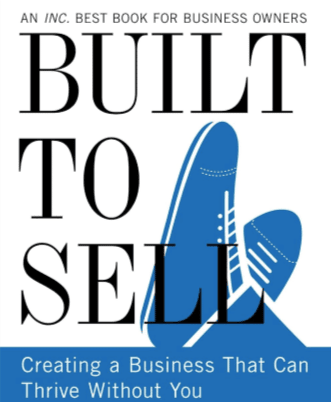
John Warrillow's Built to Sell earns its place here because it is the one book that forces founders to confront what this issue has been arguing from the beginning, that building a business and building one that can stand without you are not the same achievement, and most founders only discover the difference when it is already much harder to do anything about it. |

